


New Zealand - Waitomo, Hobbiton, Rotorua
- Feb 28
- 8 min read
Hello Family and Friends,
We took a 4 hour flight from Melbourne, Australia to Auckland, New Zealand. We will be undertaking a 3 week road trip visiting both the North and South island. After landing in Auckland, we rented a car and drove straight to the city of Hamilton. Already we are learning to roll with the punches on our road trip. Our plane was delayed leaving and so we arrived to Hamilton later than we planned. The lodge, where we had made a reservation, had given our room away. So now it's 9pm at night and we don't have a place to stay. But there was no panic, Brett always figures things out. We stayed at a hotel in the middle of town. Brett was able to get us a king suite with a bathtub. We were very comfortable.
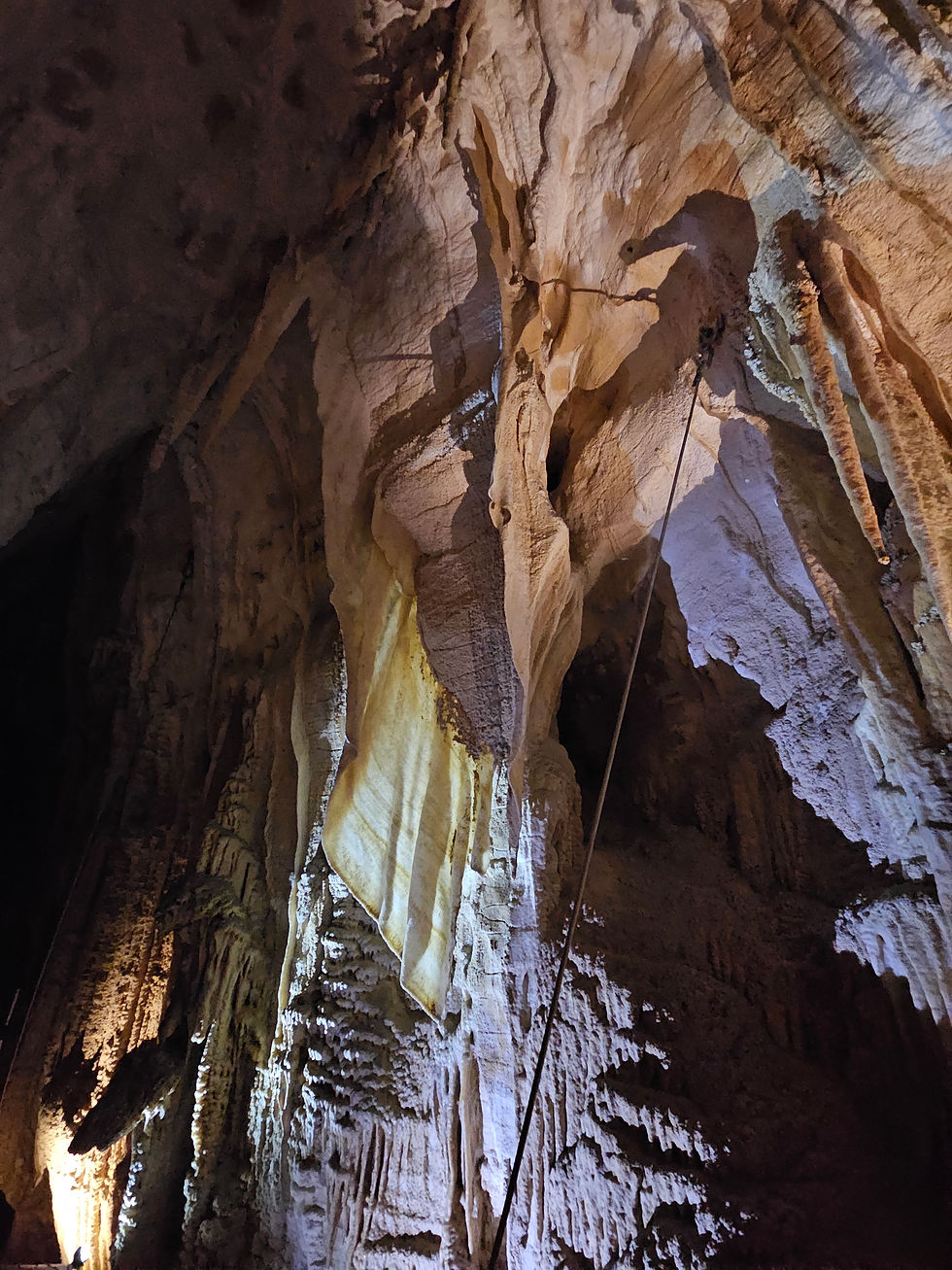
The next morning we drove about an hour and a half away to visit Waitomo caves. We took about a 90 min tour of one of the smaller caves, Ruakuri.

Ruakuri is a Maori word that means "two dogs". The cave is named as such, because the cave was discovered due to two dogs running out of the cave. We were unable to enter the cave by the original entrance because that entrance was used as burial grounds for the Maori and there are still bones located at the top of the entrance.


While on our cave tour we also ran into some tubers. They are tubing down the river that runs through the cave, often in pitch black darkness with only a headlamp to guide them. They start the tubing adventure with a backwards trust fall into pitch black river. We would have loved to do that, but we'll have to wait till Atlas is 14 years old.
Another highlight of the caves are the glowworms.

The life of a glow worm is interesting. They spend 9 months of their lives as larvae. As a larvae it glows to attract food into it's sticky stalactite structure.

When it becomes an adult fly, it only lives for about 7 days. It is unable to eat as it's mouth is undeveloped. It mates and lays eggs in that 7 days before it starves to death.
Besides the glowworms, we also learned that caving is one of the most popular sports in Waikomo because of all the caves.

We then headed to lunch in a nearby town.

We happened to catch a train going by in the station which Atlas loved. He was very upset when he realized we weren't going to be riding the train...at least not today.

The next day we left from Hamilton and headed to Hobbiton.

Hobbiton is located on a farm in Matamata, New Zealand. When the location scout was scouting out locations he was looking for a big tree with a pond and rolling hills and this farm checked those boxes.

It wasn't until the filming of the Hobbit that Hobbiton was created. After Lord of the Rings was filmed, no one anticipated the film's success so the entire set was torn down except a set of stairs leading to Frodo's house.

Once you visit the Hobbiton set you understand why Lord of the Rings and the Hobbit were so well done under Peter Jackson; he was a perfectionist down to the smallest detail. The tree in the background of the above picture is completely fake. It is made of concrete and silk leaves from China that they hand painted and tied on, twice, after the first set blew away. This is not the only artificial tree in the movie. Peter Jackson needed a plum tree, because that is what it said in the book, but they didn't have a plum tree. They stripped an apple tree of it's apples and leaves and tied on plum fruit and leaves. That kind of attention to detail is insane to me, but you have got to love the product.
Brett is a way bigger fan than me. When we were planning this trip, there were no tickets available to Hobbiton the entire time we were going to be in New Zealand. I actually dared to utter the phrase, "We don't have to see Hobbiton?" Brett was like if you go to New Zealand and don't see Hobbiton than I'm not sure you can say that you have been. Hobbiton was a non-negotiable part of the trip. It really is a very well done tour and the set is beautiful.

Our consolation prize for bringing a two and a half year old on a Hobbiton tour is that we had a hobbit sized person for photos.


In all honesty, the Hobbiton tour is actually very kid friendly. Whenever you are allowed into a hobbit hole they let you touch and sit on everything. I guess they know that true fans act like children.

My favorite part was going into Samwise Gamgee's home, which they had fully decorated. I could have spent a solid hour or more walking around and noticing all the details they added to make the home feel like it was currently being occupied. Including everything from running water in the kitchen and bath to flushing toilets (which they explicitly told us not to use)


Being at Hobbiton made me wish I was more of a fan. I really enjoyed the tour and learning about the behind the scenes work that made it all possible. I'm glad Brett didn't take me up on my suggestion to miss Hobbiton.
After our visit to Hobbiton in Matamata, New Zealand we drove to Rotorua. There are Māori people in this area that are keeping their traditions and heritage alive. We visited Te Puia which host geysers, hot springs, mud pools, a Kiwi sanctuary (the national bird of New Zealand and a nickname for New Zealanders) and a wood carving and weaving school.

Our guide was Māori and very pleased to share his heritage with us. He even started tearing up a little when explaining that the money we spend on tickets helps to support students at the school and keeping the Māori traditions alive.

Mikaera told us that the mud facial products that help reduce wrinkles comes from this valley.
We also got to see the Pohutu geyser both during the day time and at night. This is one of the more popular geysers because it goes off every 45 min on average.


One thing that Brett and I noticed right away with geysers in the states versus geysers in New Zealand is how close they let you get to the thermal activity. When we were in Yellowstone national park and watching Old Faithful, the closest we could get was about 200' away. Throughout Yellowstone there was no way to touch or interact with any of the thermal pools, not even the small ones. In New Zealand, they even have thermals that the locals children and teens will mud bathe and hangout in. While we were there we were getting sprayed by the geyser water while it was erupting. At first I thought it was raining because it was cool but, then realized it was the geyser, because when the wind would change directions I would get wet.

It's cool (or hot?) to get to be so close to something so powerful even if it is a little dangerous.
There was this one pool of water called "Bluey's pool". This is where the Māori bathe. They cover themselves in mud and then go wash off in the pool. Our tour guide told us that they have to fight their adolescent children to bathe. However, they can easily get their children to bathe if they take them to Bluey's pool. I thought it quite funny that I bribe Atlas with the TV show Bluey and the Māori bribe their kids to bathe with a pool named Bluey.

We also got a tour of the carving and weaving school. Mikaera told us that the carvings aren't just images but also language.
Everything about the Māori is saying something. Nothing they do is just because, it all serves a purpose. For example, what they carve as tombstones tells the whole life story of a person.


We ended our tour with a traditonal Māori welcome ceremony and dancing.
Once we were fully vetted as a friendly group we got to enter the lodge and see some traditional Māori dancing.
Besides Atlas clapping on beat (makes me feel like a proud black mother), my next favorite dance was the Haka. It didn't last nearly long enough. But Haka is traditionally a warriors dance. It was used to intimidate an enemy. Now it is used at sporting events to intimidate the opponent and used as celebration.
Brett and I were a little concerned that the Māori experience would be exploitative. We were so pleased that the entire experience is Māori owned and run and all proceeds are used to benefit and share Māori culture.

Our first week in New Zealand has been full of new adventures. So far New Zealand is a homerun on the list of must see places.


Comments