


Medellín, Colombia - Week 2 (Capital of the Mountain)
- Nov 1, 2025
- 6 min read
Hello Family and Friends,
This week should be called the week of tours. We are really trying to figure out what this place is about and tours are our favorite way. Obviously Comuna 13 has an amazing story of resilience and overcoming adversity, but what about the rest of Medellín?
So we started the week off with a fun tour of the center of the city. We had the opportunity to ride the metro and the cable cars. The cable cars here in Medellín aren't a tourist attraction, but an integral part of the metro system. Medellín is quite a large city and people who live in the mountains feel very disconnected from the rest of the city. The cable cars help to connect those who live in the mountains to those who live in the center of the city. As an example one of the cable car lines turned a 2.5 hour commute into just 22 minutes!

Brett was so impressed with the ingenuity to build public transportation over ground. It eliminates expensive, time consuming and labour intensive tunnels and bridges. Brett feels that all cities should have cable cars. They say that the cable cars are very reliable and only have to shut down when it's really windy.

We were also impressed with the metro system itself. The cars are wide and very clean. The one downfall is that the system is limited in it's reach.

As a part of their public transportation system they also have city bikes. "Los paisas" (this is the term for people from the Antioquia region) don't like to say that the public services are free but rather that they are covered by their taxes. They also have an extensive bus network that takes you to where the metro doesn't. However, they don't advise tourist to ride these as the routes and stops aren't posted or clear. Somehow the locals know which bus to get on and where it is going. The buses are privately owned and we hear that you get on the bus going in the direction you want to go and then you just tell it to stop where you want it to.
We also visited the open air Fernando Botero museum. He was a Colombian that really was more of a painter who also did sculptures. He wanted a museum that is available to all people, so he had them put it outside. His style is very distinctive as he plays with gigantism. Once you have seen one of his pieces it is easy to recognize his style.


Another day we took a bike tour up to Pueblito Paisa. It is a public park that is representative of what an old town in Medellín would have looked like.

To get to the town we had to ride our bikes uphill. Brett and I had it easy as we had hub drive electric bikes. Essentially we just moved our legs in a circle and the bike pushed us up the hill. Some of our tour companions opted for manual bikes. Let's just say we got to the top of the hill without breaking a sweat and waited for them to struggle their way up to us.
We also rode through the center of town which I loved. There were so many people and so much going on. Our tour guide told us to have a little patience as the bike paths were put up as an afterthought and often go through heavily pedestrian areas. Brett and I didn't mind. We thoroughly enjoyed using our bike horns to warn people of their impending doom if they dared step in our way.

We also rode through "Estadio Atanasio Girardot", which is a huge stadium complex that was built for the latin american games. Now it's a public space open to the citizens. Paisas have access to pools, volleyball courts, full gymnastics area with equipment, boxing gym and skateparks that aren't free, but covered by their tax dollars. I'll tell you one thing that Medellín has going for it and that is it's civic pride. Los paisas are very proud of what their tax dollars provide for them.

For the weekend we pulled a classic McKinney move and decided on Thursday afternoon to book a flight to Cartagena for Thursday night. Cartagena is on the Caribbean coast of Colombia. We had heard that it is where a large population of black Colombians reside.
The vibe in Cartagena is legit. The people there are more open than in Medellín and have a little more spice to them. Even the food in Cartagena is spicier than anything we have had in Medellín. Cartagena was actually the first city of Colombia that was colonized by the Spanish.

It was a strategic location because of the bay that was a natural protection of the city. Then the Spaniards brought in African slaves to build the city and the wall which also offered protection. The city was so strategically designed that it became the place where all the gold taken from Colombia would be sent before it was shipped to Spain. The walls offered protection to the city from attacks by the sea. There is also a castle behind the city, not truly a castle, but a fortified hill ( San Lázaro) that offered protection for the city from attack by land.

A battle that the English would rather forget was fought at this castle. As it happens the English has spent 3 weeks breaching the bay of Cartagena. After breaching this bay they felt that the battle was pretty much won and sent word the the King of England that Cartagena would be his within a few days. The King of England was so excited that he had a coin made celebrating his win of Cartagena.

However, Admiral Blas de Lezo dealt an embarrassing defeat to the British by taking his last stance at Castillo San Felipe de Barajas. The tunnels were instrumental in defeating the British. The tunnels were built short.

Also the British just didn't know how the navigate the tunnels as the Spanish built them to be a labyrinth. There are passages leading to nothing. It is recommended that tourist get guides to lead them through the tunnels as tourist have gotten lost for hours and begin to panic.

Everything about this "castle" was made for battle. Even it's slanted walls was so that bombs would ricochet off instead of making direct contact. It also has holes within the walls to make it earthquake resistant. It was a really cool structure to explore.

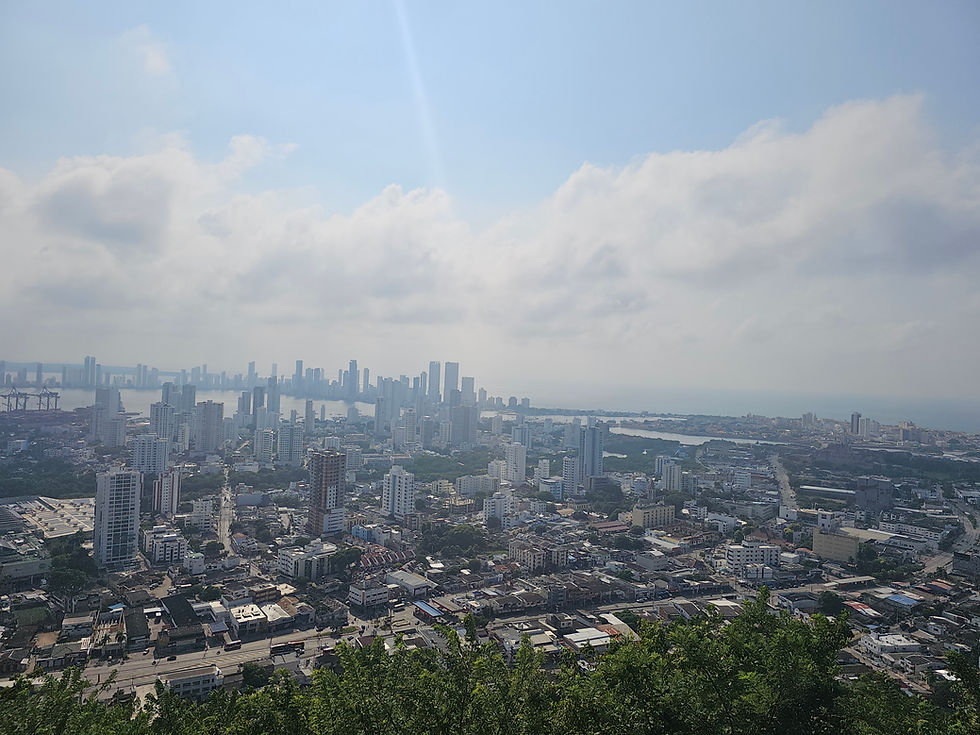
We also went to visit an old convent in Cartagena. It is the highest place in the city.
Now, we didn't just hear about battle strategies in Cartagena. We also did a sunset cruise.


We learned so much about this first city in one weekend. It's definitely got some history and grit to it. However, we could never move here. What you don't see in the pictures is the heat and humidity. It's Florida in Colombia. The temperature was 94F with a feel of 104F. We asked our tour guide and multiple uber drivers when is the coolest weather in Cartagena and they all told us that they don't have cool weather, they have rainy and dry seasons. I mean I like the heat, but I was happy to return back to the eternal spring weather of Medellín.


Comments