


Cusco, Peru ("The Heart of the Inca Empire")
- Nov 22, 2025
- 10 min read
Hello Friends and Family,
Just to be clear, we aren't looking to live in Peru. We had a week before Thanksgiving and decided we wanted to see Machu Picchu, one of the Seven Wonders of the World.

Cusco is the oldest city in in all of the Americas and much of it is nothing to look at. It looks like it has been left behind. I feel as if Cusco is what most people think of when they think of South America; just little brick and tin houses thrown together.
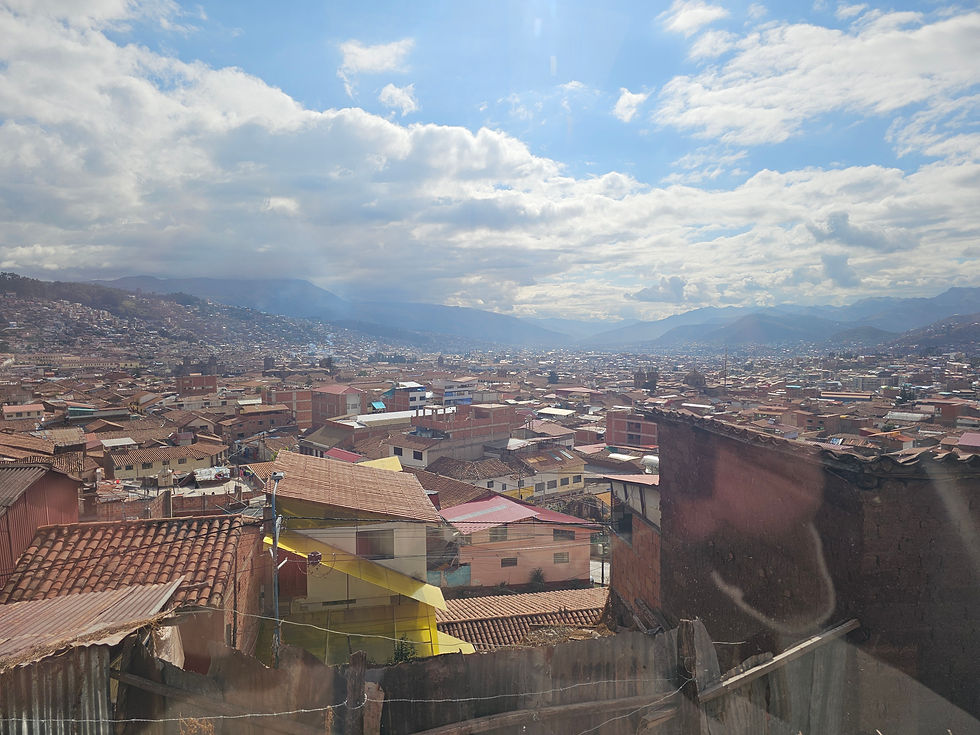
However, what Cusco lacks in architecture it more than makes up for in beautiful landscape.

Peru is set against the Andes mountain and they are amazing. Cusco itself is at about 11,250 feet and the mountains surrounding it reach up to 22,000 feet. Due to it being near the equator the snow doesn't start until about 20,000 feet around this time of year.
The story of Cusco is that the Quechua people came down from Bolivia which is at an altitude of 15,000 feet. Brett and I were just so amazed that they came from 15,000 feet and felt 11,000 feet was so much better. At 11,000 feet both Brett and I were feeling a little bit of the altitude sickness.
You may be more familiar with the term Inca(Inka) in reference to the Quechua people. However calling them Inca or Incan is technically incorrect as it was only the king who was called Inca. Just as we wouldn't call british citizens Kingans. The people spoke (and some still speak) Quechuan and are therefore called according to their language.

Once we arrived to Cusco we had excellent service and a surprise guest waiting at the front of our hotel room.

The next morning we took the train up to Cusco.


We took the train from Cusco to Agua Calientes, which is a town outside of Machu Picchu. Our hotel picked us up from the train and brought us to the hotel.


We were fortunate to get both route 2 and 3 of Machu Picchu. The story of Machu Picchu is that the Quechua people used it as a lab. It was a settlement of about 500 people in which most of the people were nobles studying the Amazon.


There is so much history to this city and if you ever get a chance to go, I highly recommend it. It is absolutely amazing how the Quechua people built their city and lived their life. And when you look from the city out into the mountains, it seems like it was an absolutely incredible place to live.
Machu Picchu is apart of a larger area called the Sacred Valley, which consist of Quechua towns that hold temples to the Sun God. The temples are all built in such a way that the sun would set in specific location so that the Quechua people would know when the solstices were and consequently when to plant and harvest.

Upon leaving Agua Calientes we took the train to another part of the sacred valley, Ollantaytambo.

What's so interesting about Ollantaytambo is that it is considered a living Quechua city. There are people who still speak the Quechua language and still live the traditional Quechua life style.This is also another location of a sun god temple. The story of how they built the temple does sound like something alien. In order to build the temple they dragged these huge 55 ton stones from 7 kilometers away both down and up mountains. Just to demonstrate this was possible national geographic had 200 people drag a 15 ton rock for 20 meters over straight flat ground and it took 2 days!

We then ventured away from Ollantaytambo to visit the salt marshes. There used to be 4000 different pools, but now there ware 3000 due to the collapse of almost 1000 pools. The mines are owned by local families and they sell it to one company who then distributes it to the world. (your Himalayan pink salt may not be from the Himalayas)

After we visited the salt mines we went for a little tasting of the various types of salt. We learned that the top layer is the white salt, the middle layer is the pick salt and the bottom layer is the red salt. Only the top two layers are consumed by humans. The bottom layer is used for bath salts and animals. While at the tasting we also learned that there are 1000 different types of potatoes and 200 different types of corn in Peru, most developed by the Quechuan over centuries of hybridization and selection. This explains why the french fries taste different in South America. We also got to try Chicha which is a fermented corn beer. Supposedly this drink is what gave the Quechua people energy to build all their towns and cities, and dulled their sense of pain.

We also saw some guinea pigs or "cuy" in spanish. We asked the owner of they were pets or food. She said they were food. We actually didn't try guinea pig while in Peru. We consider ourselves fairly adventurous eaters and like to explore the local cuisine of all the places we visit. I mean in Mexico we tried grasshopper. It was in a sauce and we lived to tell about it. However, traditionally, guinea pig in Peru is served in the shape of the guinea pig and we just couldn't bring ourselves to try it.

The next stop on our tour was an area called Moray(pronounced Moor-eye). This was Brett's favorite location yet again displaying the genius of the Quechua people. Moray was another lab that was used to experiment with growing different crops in different micro climates. Each of the terraces represent different altitudes and climates of the various cities in their empires. After collecting data they would distribute the seeds to the cities that grew best in their corresponding ring. Hundreds of years before the scientific method these "primitive" people, as history books would have you believe, were constructing cities and testing crop yields in ways we can't figure out to this day.

Now before I leave the Sacred Valley, I have to tell you guys about our accommodation while visiting this particular area. While traveling, there have been a few places that we want to go back to strictly because of the accommodations. One is the Omni in New Hampshire and the second is the Mr & Mrs Smith in Ollantaytambo. The accommodations are the perfect definition of "glamping". We arrived in the evening, but were able to catch dinner in the restaurant in which the majority of the menu is locally sourced. Then Brett and I laid a blanket out on the grass and did a little stargazing. While star gazing Brett pointed out that there were dark spots in the sky. In the morning, we realized that those dark spots in the sky were the mountains that were surrounding us on all sides.

The property really is a gem, in a beautiful location and so very relaxing. Wherever we end up calling home, we will definitely come back to this little treasure of Peru.
Our last location within the sacred valley that we visited was Pisaq. Just getting to Pisaq was an adventure all unto itself. We took a local form of transportation called a "collectivo". It is a hybrid between a traditional city bus and a rideshare service. Collectivos are 10-15 passenger vans that go between the various cities around Cusco. They wait until the van is full and then they leave. Well our van was full and we were headed from Cusco to Pisaq. While driving through the city the van door started to open and then it closed. The driver stopped and then about 9 school kids proceeded to hop on our bus. Remember our van is full. So these kids do a mixture of standing and sitting in the isles.

The kids were between 8-11 years old. I know because I asked the two young boys sitting on the floor beside me their ages.

We figured either there are no school buses or these kids live too far away for the school bus to take them home. These kids rode on the collective for probably an hour before reaching their destination. And as kids will do they got a little antsy and started tussling. Well Atlas decided he needed to get involved as well. He started pushing the boys chest and grabbing their arms while yelling at them to stop pushing each other. They completely ignored him.
Honestly the little boy in the video was really kind. He didn't mind Atlas pushing on him at all. Once the young boy in the video reached his stop I thanked him for being kind to Atlas. We had taken a collective before, but it was in the evening time. So this midday collectivo experience of kids just opening the door of a moving van, and hopping in just had to be shared.
Once we arrived in Pisaq, we decided not to take a tour guide for this one, but just take it at our own pace. Again we were just stunned by the location of the city and the view. Just the grit of the Quechua people to build such grand things in such a rough terrain.

We finished off our time in Peru with a few nights in Cusco. We stayed at another great property, Palacio del Inca. As the name indicates, it was and Inca palace. As apart of the entertainment of the hotel, we had some live traditional Andes music.
We also had a pisco sour tasting. This is a very popular drink in South America of which I'm not really a fan (as Brett is finding out while editing this post).

Our last day in Cusco was probably our most tumultuous and this turmoil lasted for 48 hours until we got back to the states. Let's see how can I tell this story without also making you exhausted from reading it. Let's just say that this is the first time that traveling with Bruce has given us some real trouble.
With every country we have been to we always have to get Bruce checked out before we leave one country and head to the next. Most of the time it's a wellness and vaccine check and we're good to go. However, in Peru we spent all day going to the vet and then to the government office for them to give us an official paper of what the vet gave us and then back to the vet to get the vet to sign the paper. Believe it or not, that was the easy part.
We then get to the airport in Cusco where they don't check any of the paperwork we just spent our entire last day running down. We put the paper work in our carry-on luggage which we then check plane side because the plane is full. We think we are good because the next time we will need the paperwork is when we go through customs in Atlanta. However, right before we board our connecting flight in Lima (with the same airline) they decide they need to see our dog's paperwork which is now underneath the plane.
We end up missing that flight because they won't let us fly without seeing the dogs paperwork. They tell us they are going to pull all of our bags off of the plane because bags can't fly without passengers. They pull our checked luggage but not the luggage we checked plane side. So we still don't have the dog's paperwork, we are stuck in Lima and part of our luggage is on it's way to Atlanta without us (and against airline and federal regulations). We are then transferred to fly on another airline 12 hours later because this airline doesn't have another flight to Atlanta for another 3 days!
However, this airline is an American based airline and they understand that the US isn't going to prevent American citizens from getting back into the country with their American dog over some other country's paperwork.
So 12 hours after we were originally scheduled to land in Atlanta we land in Atlanta to find that our bags have been lost. So we still don't have the dog's paperwork nor do we have our luggage. And did anybody care about our dog, you best believe they didn't ask not one question. They saw the dog and saw our passports and said, "Welcome home". The adventures of traveling internationally with your pet (Brett: furry family member!). Hopefully you're not as tired from reading about our luggage disaster as we were living it, but if you want more details or to watch Brett blow a gasket ask him about it.
We made it back to Alabama for the holidays and the airlines did (eventually) find our bags before we left for our next location, Santiago, Chile. For my semester abroad while in college, I studied about two hours outside of Santiago in Vina del Mar . I am excited to reconnect with my Chilean host family.


Comments